
Whatever the problem
〰️
Whatever the problem 〰️
Mindfulness
is the solution
Meditate With Ranga | Mindfulness Speaker & Teacher | NJ, NYC, Philadelphia
Wellness Programs | Mindfulness Workshops | 1:1 Coaching
〰
〰
Before you had an occupation
before you could speak
before you knew your name
You had present moment awareness
It’s a gift. It’s your birthright. It is available, always, here and now.
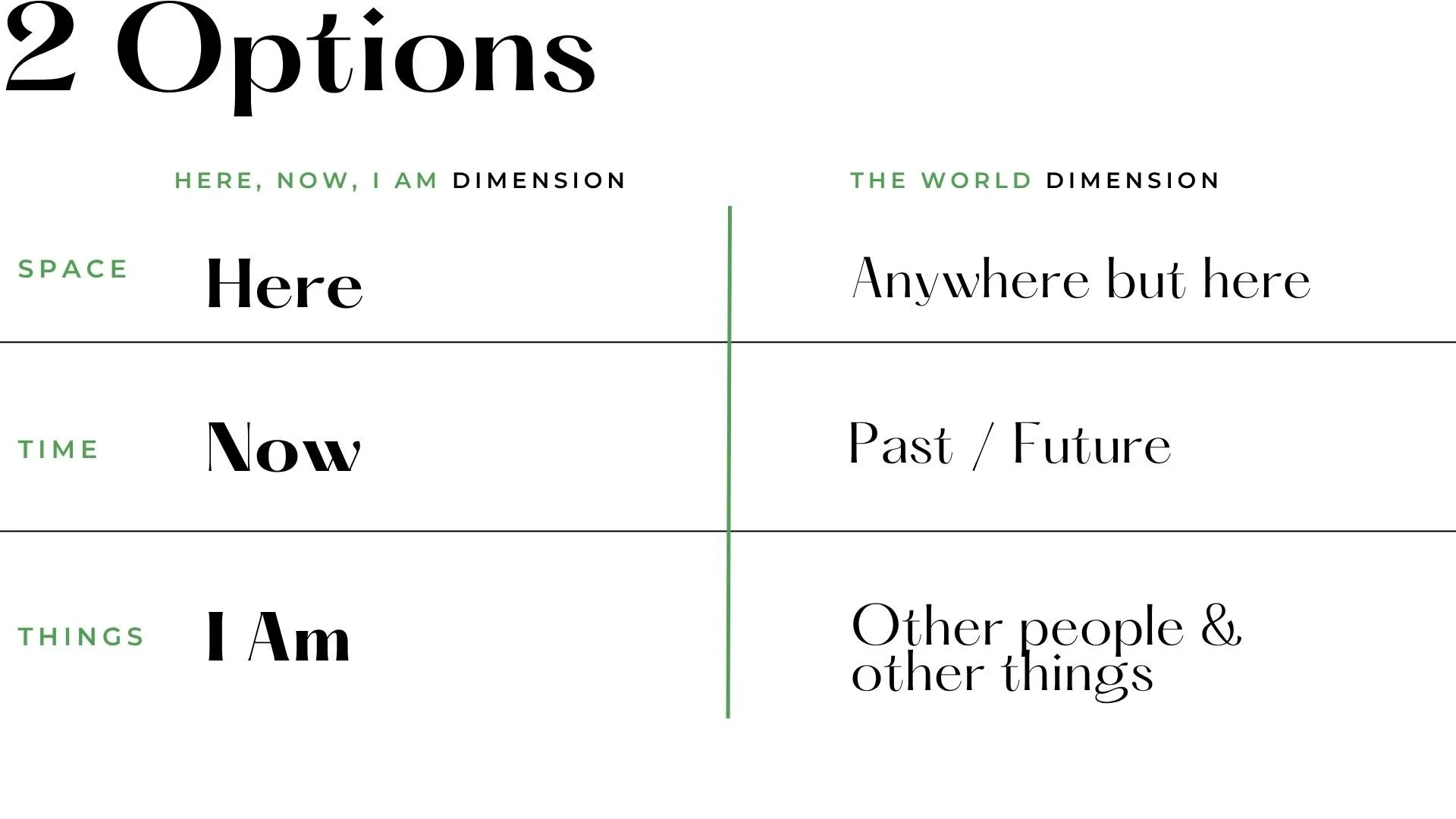
The Here, Now, I Am domain is always here. In terms of space, it is here. In terms of time, it is now. In terms of things, it is “I”. Whenever the mind comes to this domain, regardless of what you are doing, you feel well. The world dimension is everything else. It is dramatic, full of excitement and news, and with it comes a never-ending supply of tension and frustration.
But present moment awareness is boring! It is monotonous. Our crazy minds don’t like it! Take a sports fan: we are all born naked, alone, with no affiliation to any team, but when introduced to a sport, we pick a side — and suddenly the season is full of drama, hysteria, trauma, and elation. But if we don't pick a side? Then there’s no game! No tension. No frustration. No story. The mind is at zero, and everything becomes null and void.
When the mind becomes acquainted with the present moment, it begins to compare it with the dimension of “the world.” Then, slowly, we see that we create our own turmoil and then cry about it. The day you appreciate mindfulness, you will see all crying as falsified crying.
Learn the Path of Least Friction
〰️
Be happy regardless of circumstance
〰️
Be mindful & MIND YOUR OWN BUSINESS
〰️
Learn the Path of Least Friction 〰️ Be happy regardless of circumstance 〰️ Be mindful & MIND YOUR OWN BUSINESS 〰️

25 Years of mindfulness practice
6 Years of Teaching Experience
13 years of corporate & startup experience
Anyone can be mindful,

while doing anything
Proven Results
-
At Aetna, nearly 15,000 employees participated in at least one yoga or meditation class and reported on average a 28% reduction in stress levels, a 20% improvement in sleep quality, and a 19% reduction in pain. They also gained an average of 62 minutes per week of productivity each, which Aetna estimates is worth $3,000 per employee per year. Association for Talent Development Medical claims fell 7.3% in 2012, amounting to $9 million in savings.
A Duke University assessment of Aetna's program found an estimated 11-to-1 return on its investment in mindfulness training, quantified as a $6.3 million positive impact on the bottom line.
At General Mills, after a seven-week mindfulness leadership course, 83% of participants reported taking time each day to optimize their personal productivity — up from 23% before the course. Association for Talent Development
A meta-analysis of 56 randomized controlled studies with over 5,000 participants (Lomas et al., Mindfulness, 2019) found that workplace mindfulness programs effectively reduce stress, burnout, and mental distress while improving wellbeing, compassion, and job satisfaction.
Workplace stress costs U.S. businesses an estimated $300 billion annually in healthcare, absenteeism, and lost productivity. CUNY Pressbooks The World Health Organization estimates that every $1 invested in mental health interventions yields approximately $4 in improved health and productivity outcomes.
Companies with formal mindfulness programs include Google, Apple, General Mills, Goldman Sachs, Nike, Ford, Intel, McKinsey, IKEA, LinkedIn, and the U.S. Marines — spanning manufacturing, finance, technology, and defense.
-
Mindfulness meditation produces significant reductions in anxiety, depression, and psychological distress. A landmark 2014 meta-analysis in JAMA Internal Medicine (Goyal et al.) reviewed 47 randomized controlled trials with over 3,500 participants and found effect sizes comparable to antidepressants for mild to moderate presentations — without the side effects.
Mindfulness-Based Cognitive Therapy (MBCT) is now formally endorsed by the UK's National Institute for Health and Care Excellence (NICE) as a recommended intervention for preventing depressive relapse, with evidence showing it reduces relapse rates by approximately 40–50% compared to standard care.
Richard Davidson's research at the University of Wisconsin identifies four trainable constituents of wellbeing measurably improved by meditation: resilience (the speed of recovery following negative events), positive outlook, the capacity to sustain attention, and generosity NIH Record — all supported by neuroimaging evidence.
Davidson found that regions of the brain intimately involved in the control and regulation of attention, such as the prefrontal cortex, were more activated in long-term meditation practitioners Waisman Center. Even experienced meditators exposed to disturbing stimuli showed significantly less emotional reactivity in brain areas governing decision-making — the noise registered, but without the emotional charge.
In long-term practitioners, gamma oscillations — fast-frequency brain waves associated with focused attention, learning, and conscious perception — were present for minutes rather than the fraction of a second typical in non-meditators, and were visible to the naked eye, which Davidson noted is almost unheard of in this kind of research Harvard GSAS. (Lutz, Greischar, Rawlings, Ricard & Davidson, PNAS, 2004)
-
Nobel Prize-winning biologist Elizabeth Blackburn co-authored research as part of the UC Davis Shamatha Project showing that telomerase activity — the enzyme that rebuilds and lengthens telomeres, the protective caps on chromosomes that shorten as cells age — was approximately one-third higher in meditators who completed a three-month retreat compared to a matched control group UC Davis. (Jacobs, Epel, Lin, Blackburn et al., Psychoneuroendocrinology, 2011)
Blackburn and Epel's subsequent research, summarized in their book The Telomere Effect (2017), established that chronic psychological stress accelerates cellular aging by shortening telomeres — and that mindfulness practice appears to interrupt this process by reducing the stress response that drives telomere erosion.
A systematic review and meta-analysis of 45 randomized controlled trials found that meditation reduced cortisol, C-reactive protein, blood pressure, heart rate, triglycerides, and tumour necrosis factor-alpha ScienceDirect — a broad range of physiological stress markers. All meditation subtypes reduced systolic blood pressure. (Pascoe et al., Journal of Psychiatric Research, 2017)
Mindfulness-based interventions have been shown to reduce pro-inflammatory cytokines and increase anti-inflammatory cytokines, with moderate-quality evidence across randomized controlled trials — suggesting a meaningful effect on immune function.
Multiple randomized trials demonstrate that Mindfulness-Based Stress Reduction (MBSR) reduces pain-related disability and improves quality of life in patients with chronic pain conditions — not by eliminating pain, but by changing the practitioner's relationship to it.
Duke University found an 11-to-1 return on Aetna's investment in mindfulness training.
〰️
Companies with formal mindfulness programs include Google, Apple, General Mills, Goldman Sachs, Nike, Ford, Intel, McKinsey, IKEA, LinkedIn, and the U.S. Marines.
〰️
Duke University found an 11-to-1 return on Aetna's investment in mindfulness training. 〰️ Companies with formal mindfulness programs include Google, Apple, General Mills, Goldman Sachs, Nike, Ford, Intel, McKinsey, IKEA, LinkedIn, and the U.S. Marines. 〰️